

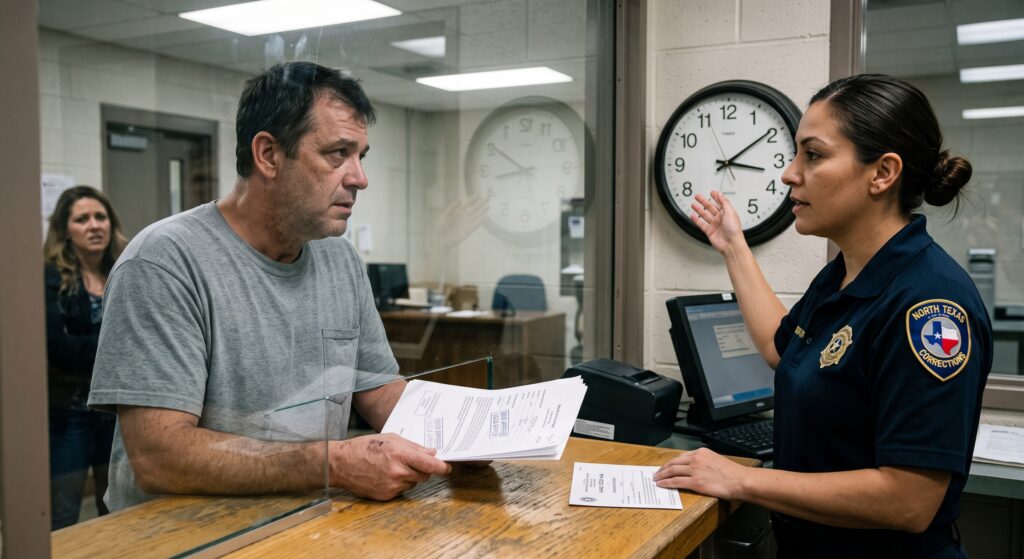
You’ve done everything right. You called a bondsman, paid the premium, signed the paperwork, and now you’re sitting at the jail release desk waiting for your loved one to walk out. Then you hear it: “We can’t release them yet.” The bond is posted. Everything looks complete. And yet the answer is no, not right now.
This isn’t a mistake, and it isn’t the bondsman failing to do their job. Family violence arrests in Texas are handled differently than most other offenses, and the system intentionally slows the release process down. Safety takes priority over speed in these specific cases. What you’re running into is a legally required hold, commonly called a cooling-off period, and understanding how it works changes how you plan the whole release.
What Is the “Cooling-Off” Period in a Texas Family Violence Arrest?
Texas Code of Criminal Procedure Article 17.291 gives law enforcement agencies the authority to hold someone suspected of family violence even after they’ve met all bail requirements. In plain terms, posting bond doesn’t guarantee an immediate walk-out the way it typically does with other charges.
The purpose behind this law is straightforward. It gives emotions time to settle, reduces the chance of immediate re-escalation, and gives the complaining party a window to find a safe environment or pursue an Emergency Protective Order if needed. It’s a safety mechanism built directly into how these cases are processed, not an administrative delay or an oversight at the jail.
The standard hold under this statute is up to 24 hours after bond has been posted. In certain cases, a magistrate can extend that to a full 48-hour hold family violence window if there’s written evidence suggesting violence is likely to happen again upon release. Either way, the hold is a legal requirement, and no bondsman has the authority to bypass or shorten it.
Emergency Protective Orders (EPO) and Common Family Violence Bond Conditions
In nearly every domestic violence arrest across the DFW area, a magistrate issues what’s called a Magistrate’s Order for Emergency Protection, often referred to as an MOEP, before the defendant is released. This order sets specific legal boundaries the defendant must follow immediately upon release.
These conditions typically include a strict no-contact order, meaning absolutely no physical, digital, or third-party communication with the alleged victim. Text messages, phone calls, social media contact, and even messages relayed through mutual friends or family members all fall under this restriction.
Distance requirements are also standard, usually requiring the defendant to stay somewhere between 500 and 1,000 feet away from the alleged victim’s home, workplace, or a child’s school. In some cases, GPS monitoring is ordered as well, requiring the defendant to wear an ankle monitor, typically at their own expense, so their location relative to excluded zones can be tracked.
It’s critical for both the defendant and the co-signer to understand the consequences of violating any of these conditions. A violation isn’t treated as a minor infraction. It’s a separate, arrestable criminal offense, and it will immediately trigger a bond forfeiture, sending the defendant back into custody. For a co-signer, that forfeiture can carry serious financial consequences on top of the legal ones.
Why You Still Need to Post Bail Immediately During a Hold
This is the part families most often get wrong, so it deserves special attention. The 24-to-48-hour cooling-off clock typically doesn’t start until the bond has actually been approved and posted with the jail. Waiting to contact a bondsman until you think the hold period is “almost over” doesn’t save you time. It only delays everything further, since the clock hasn’t even started yet.
The smart move is to post bail as early as possible, even knowing the release won’t be immediate. Once the bond is posted, jail staff can begin processing the release paperwork and queue the defendant for release. That means the moment the hold officially expires, whether that’s at hour 24 or hour 48, the release can happen right away instead of waiting on additional administrative steps.
Navigating Sensitive Releases with Big Bubba’s and 1st Call
Domestic violence arrests are emotionally charged for everyone involved, including the co-signer trying to help. Our agents approach these cases with complete confidentiality, zero judgment, and a professional demeanor from the first phone call to the final release.
Because a cooling-off hold can expire at any hour of the day or night, our teams remain on call around the clock. Whether that hold ends at 3 p.m. on a Tuesday or 4 a.m. on a Sunday, we’re positioned to coordinate with jail release desks across Dallas, Tarrant, Denton, and Collin Counties so the release happens the moment it legally can.
If you’re navigating a family violence arrest anywhere in the Metroplex, call Big Bubba’s Bail Bonds or 1st Call Bail Bonds. We’ll walk you through exactly what to expect, help you post bond as early as possible, and stay in contact with you throughout the hold period.
Contact us to get the process started.
